
The Right Sign for Your Business
Successful signage involves more than creating an attractive arrangement of logos and slogans. It is also a blending of complex elements such as marketing, demographics, an understanding of visual acuity, conspicuity, and obliquity.
Successful signage involves more than creating an attractive arrangement of logos and slogans. It is also a blending of complex elements such as marketing, demographics, an understanding of visual acuity, conspicuity, and obliquity. Complicating the task is the fact that the reader is usually moving, and the sign must be seen, read and understood in an instant.
In our highly competitive and media-rich world, an investment in professional sign design is worthwhile. Trained designers understand how to get the consumer’s attention. Most importantly, they know how to get the consumer to respond.
Remember, every major chain that exists today started out as a small business. Your long-term success can be shaped by the effectiveness of your street presence if it is professionally designed from the very beginning.
Elements of Good Signage
How well a sign works for your business depends in large part on how easy it is for people driving by to see and read it. Following is a step-by-step guide for making sure your sign can be seen and read in time for potential customers to react and stop at your business.
Signage Placement
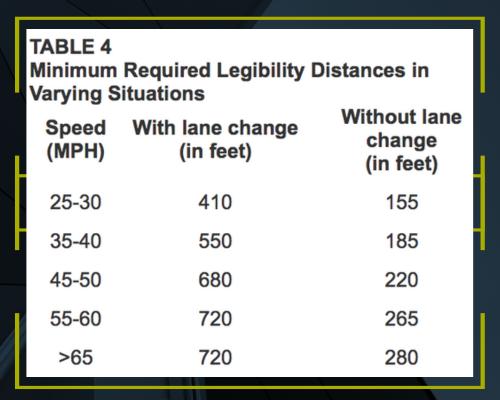
Table 4 shows what researchers learned about how far a car at different speeds will travel from the time a driver first sees the sign until the car safely comes to a stop. This assumes the sign is mounted perpendicular to the roadway and includes the amount of distance needed to read a typical sign and make a decision to stop.
If the sign is mounted on the front of the building parallel to the roadway, research shows it needs to be at least 70% larger than the sign mounted perpendicular to the roadway, or it cannot be read in time. Note that if a sign has unfamiliar words or lots of words, it will also take longer to read.
Sign Size

Assuming the sign can be seen, the next step is to figure out how large the letters on your sign need to be so that your message can be read.
Experts recommend designing signs with letters a minimum of one-inch tall for every twenty-five feet of distance. This makes them readable for all legal drivers. Note that if your sign is using fancy lettering that is more difficult to read, the minimum letter size must be increased significantly.
Most businesses are not going to be well served by a small, plain sign with no graphics. The lettering style, the ability of graphics and logos to be easily recognized, whether or not the words on the sign are familiar and easy to read, the lighting methods used, and even the colors used all impact people’s ability to see and read a sign.
Height of Sign
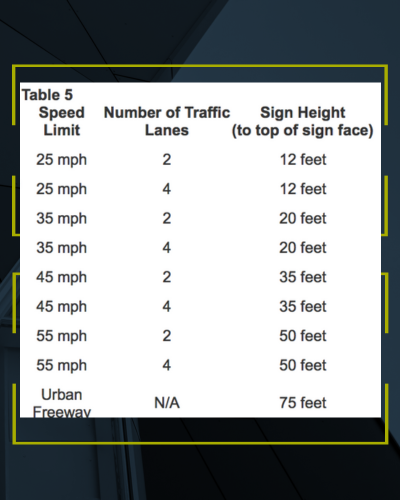
Now that you know where your sign will be placed and how large it needs to be the next question is how tall the sign needs to be. The further away the sign will be read, and the further it is from the road, the taller the sign must be to be visible from a car. Freeway signs intended to be read from great distances should be very tall; signs located in a business district with 30 mph traffic only need to be tall enough that parked and moving vehicles will not block them from view.
Although the length and content of a sign’s message generally dictates the overall sign dimensions, Table 5 sets out generally accepted sign height guidelines. They assume that the sign is mounted perpendicular to the roadway, that the size of the letters meets the minimum size standards listed in Table 4, and that the sign is mounted within 5 – 10 feet of the nearest edge of the public right-of-way. Note that although the table lists heights measured to the top of the sign face, the height from the ground to the bottom of the face should always measure a minimum of 7 feet so the sign is not blocked from view by passing or parked vehicles.
Signage Illumination

Lighting is essential for most signage. It allows your sign to be visible and readable day and night, in all kinds of weather. When a sign is illuminated, drivers can read it more quickly. Another benefit of an illuminated sign is that 24-hours a day it is advertising your business. Even when your business is closed, that constant reminder helps build memory of your business.
A wide variety of illumination methods are available, and rapidly developing technology is creating a virtually unlimited variety of possibilities, many of which are very economical to install and maintain, as well as being energy-efficient.
When you select the color scheme for your business, you should consider your sign’s illumination options at the same time, because the illumination you choose can have an effect on the sign’s appearance. Some businesses want their sign’s colors to match their print and other media advertising exactly. Some forms of illumination are much better than others at accurately displaying color.
A properly lighted sign should be bright enough that it can compete with other signs in the area without being annoying. Many cities are beginning to impose limits on brightness, so before designing a sign you should check to see what those limits might be to determine whether your sign will be visible at night.
Not sure where to start? Find an expert now.
Like what you see?
Get more ideas, design, and inspiration delivered to your inbox on a monthly basis. Sign up for our email, we won’t waste your time!