Prototypes: The Secret to Reducing Risk in Signage Projects
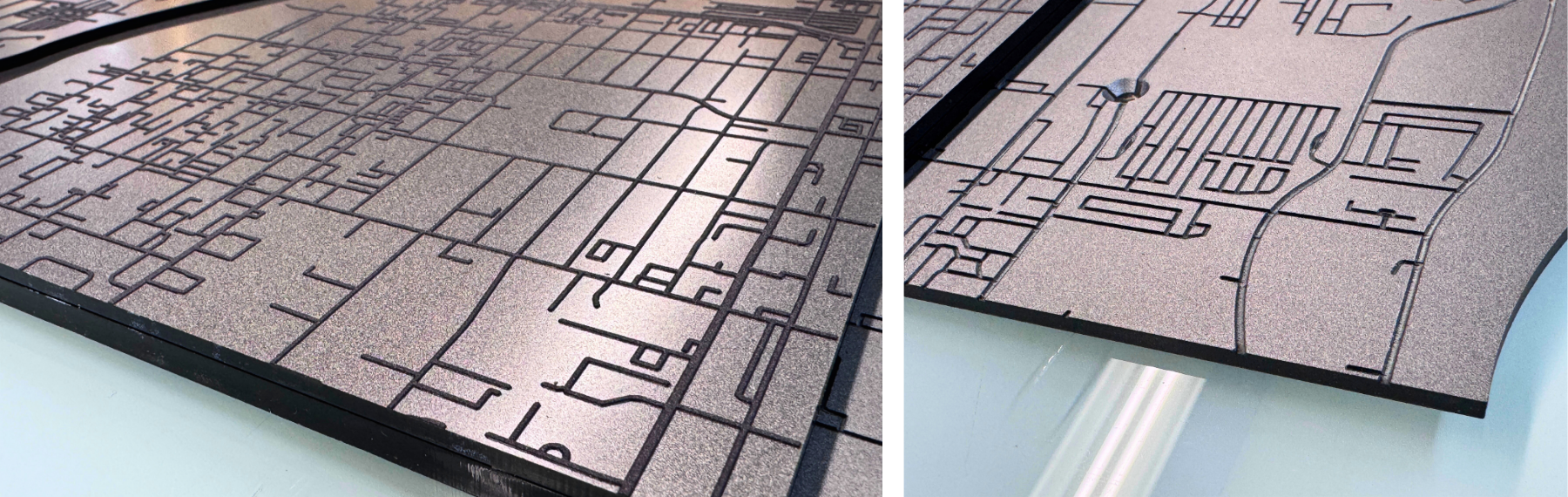
A critical step of the design-build process to ensure success is prototyping. A prototype shows you how a material will look, feel, and react to the elements. This gives us the chance to experiment with fabrication methods, materials, and colors — giving you several options to evaluate.
In architectural signage, risk refers to the technical, financial, and reputational hazards that can derail a multi-million-dollar construction project. Because signage is often one of the finishing touches of a building, any error at the end of the timeline can delay grand openings or lead to failed inspections.
What risks do we identify and mitigate at Latitude through our design-build process?
Compliance and Legal Risk: One of the most significant risks is failing to meet ADA (Americans with Disabilities Act) standards or local building codes.
- The Struggle: If mounting heights, braille dimensions, or luminance levels are off by even a fraction, a facility may fail its final inspection, delaying occupancy.
- The Mitigation: We consult from the planning stages to ensure every sign is code-compliant and production-ready, reducing the risk of costly post-installation fixes.
Durability and Environmental Risk: Signage must weather the elements and stand the test of time.
- The Struggle: Using the wrong materials for a specific climate can lead to fading, rusting, or structural failure within just a few years.
- The Mitigation: Components, surfaces, and spaces are considered early in the process to select quality materials and finishes that are both durable and aligned with the design intent.
Financial and Timeline Risk: For general contractors and project managers, the biggest risks are budget overruns and missed deadlines.
- The Struggle: Signage involves many moving parts. Inaccurate shop drawings or poor communication can cause a domino effect on the rest of the project schedule.
- The Mitigation: Transparency and responsiveness is our top priority. If costs or timelines change, you are informed immediately so you can make the best decision to move forward.
Brand and Aesthetic Risk: Your signage is the first thing a customer sees. If it doesn’t align with the brand’s vision, it creates a visual disconnect.
- The Struggle: An original concept or vision may be impossible to manufacture as originally drawn, leading to a final product that doesn’t function as intended.
- The Mitigation: We collaborate with you to design solutions that complement the initial vision. Having our production designers work directly with our sign fabricators ensures the finished product actually works in the physical space.
Visual Proof with Prototypes Mitigates Risk
One of the most critical steps of the design-build process to ensure success is the physical prototype. A prototype shows you — in three dimensions — how a material will look, feel, and react to the elements.
This step gives us the chance to experiment with different fabrication methods, materials, and colors — giving you several physical options to evaluate. Collaboration between design and manufacturing during the prototyping phase is key. Working together, under one roof, design and manufacturing ideates, tests materials, and constructs prototypes that push boundaries but hold true to the architectural design. Watch this video to hear our digital printing expert explain how helpful prototyping is during the planning and design phase:
Prototyping is an important step in verifying installation methods. Will a mechanical fastener work best, or should we go with a custom bracket? Would front-lit or back-lit letters look better? These questions are answered long before the team arrives on-site to install your finished signage.
Once you review and approve a prototype, our team creates production-ready drawings for our sign fabricators. Think of these drawings as maps showing precisely where every seam, every bolt, every wire goes.
The Design-Build Difference
When you rely on a signage expert to plan, design, manufacture, and install your signage, you minimize the risk of errors, delays, and production challenges. And that typically leads to cost savings in time and materials. Starting early, keeping everything in-house — from planning to designing to manufacturing — and creating prototypes before the first sign ever hits the manufacturing floor makes the signage process easy and effective.
Seeing is believing: Learn how our prototyping process reduced risk for a Rosenwald Courts renovation.
Are you ready to reduce risk on your next signage project? Reach out to us at connect@latitudesignage.com.
Like what you see?
Get more ideas, design, and inspiration delivered to your inbox on a monthly basis. Sign up for our email, we won’t waste your time!