Behind the Sign: How to Design a Custom History Wall for Your Facility
Summary: Corporate history walls, timeline displays, and heritage walls are powerful tools for experiential graphic design. They transform empty corridors into engaging brand narratives that build trust with visitors and boost employee alignment.
1. The Strategy Phase: Is a History Wall Right for Your Space?
Before investing in fabrication, define the foundational purpose of your exhibit. Establish your “Who, What, and Why” through three core questions:
- Why are you creating a history wall? (e.g., celebrating a centennial milestone, honoring founders, or reinforcing corporate values).
- Who is the primary audience? (e.g., prospective clients, donors, healthcare patients, or new employee recruits).
- What is the core takeaway? What specific message or emotion do you want visitors to remember when they walk away?
2. Content Curation: How to Filter Your Organization’s Timeline
One of the most daunting aspects of experiential graphic design is content overload. To prevent a cluttered, overwhelming display, adopt a rigorous curation framework:
- Historical Importance: Create a chronological list of major milestones and score them based on historical impact to the company or community.
- Visual Asset Availability: Evaluate the supporting content available for each milestone (e.g., high-resolution photography, original newspaper clippings, artifacts, or digital media).
3. Innovative Materials: Breaking the Traditional Timeline Template
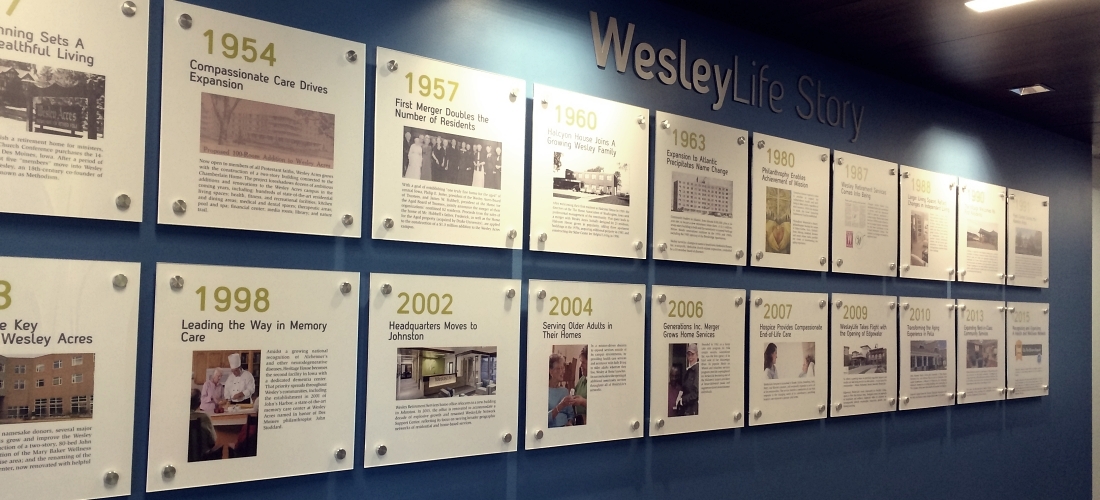
Standard history walls often rely on a predictable, linear format: rustic materials for early eras transitioning into modern aesthetics for the present day. To create a highly memorable, modern history wall, look for opportunities to disrupt this traditional template.
To maximize visual impact and draw foot traffic, consider integrating these advanced fabrication elements:
- Layered and Dimensional Materials: Utilize acrylic, brushed metals, wood veneers, and standoff hardware to make text and images jump off the wall.
- Integrated Architectural Lighting: Incorporate concealed LED strip lighting, backlighting, or accent illumination to add drama, depth, and focal points.
- Dynamic Geometric Shapes: Move away from flat grids by deconstructing brand logos or architectural lines into structural pods that protrude into the space.
Expert Tip: Try to break out of the traditional history wall look by incorporating new, or even unusual, materials that go beyond the “history wall” or “timeline” template. My goal is to create a dynamic history wall that attracts your employees and visitors to learn more about your company.
4. Proof Points: Successful History Wall Examples
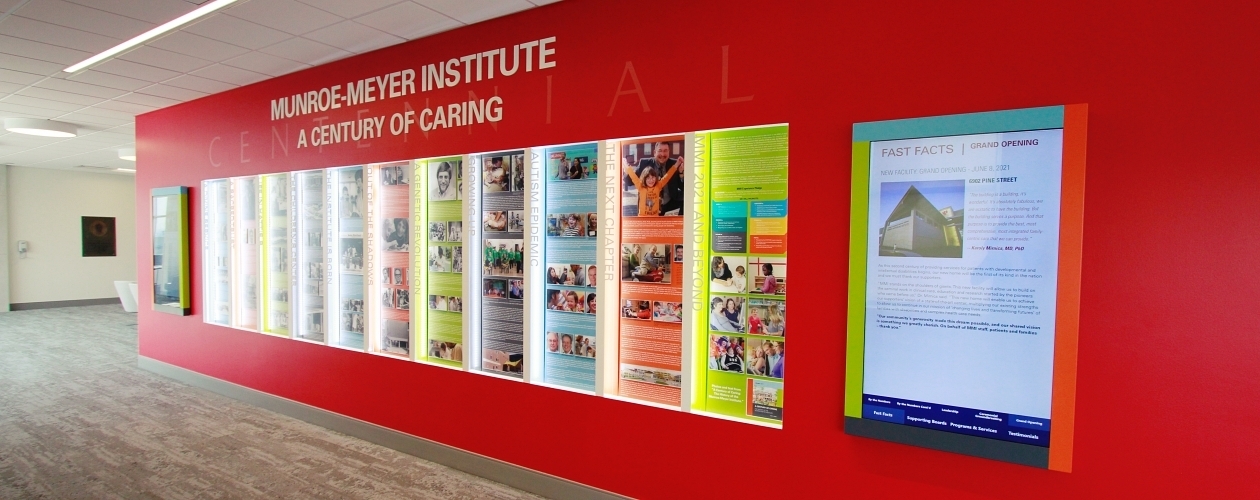
Case Study 1: University of Nebraska Medical Center – Munroe-Meyer Institute
- The Challenge: Celebrate a century of specialized healthcare and community impact.
- The Design Solution: Drawing inspiration from UNMC MMI’s centennial book, A Century of Caring, the design team extracted core narratives to establish the exhibit’s color palette and aesthetic. The final installation features large-scale dimensional panels accented by concealed LED lighting to bring depth, drama, and modern sophistication to a deeply historic narrative.
Case Study 2: Carson Group Headquarters
- The Challenge: Showcase a multi-decade financial legacy inside a highly modern, bold corporate headquarters.
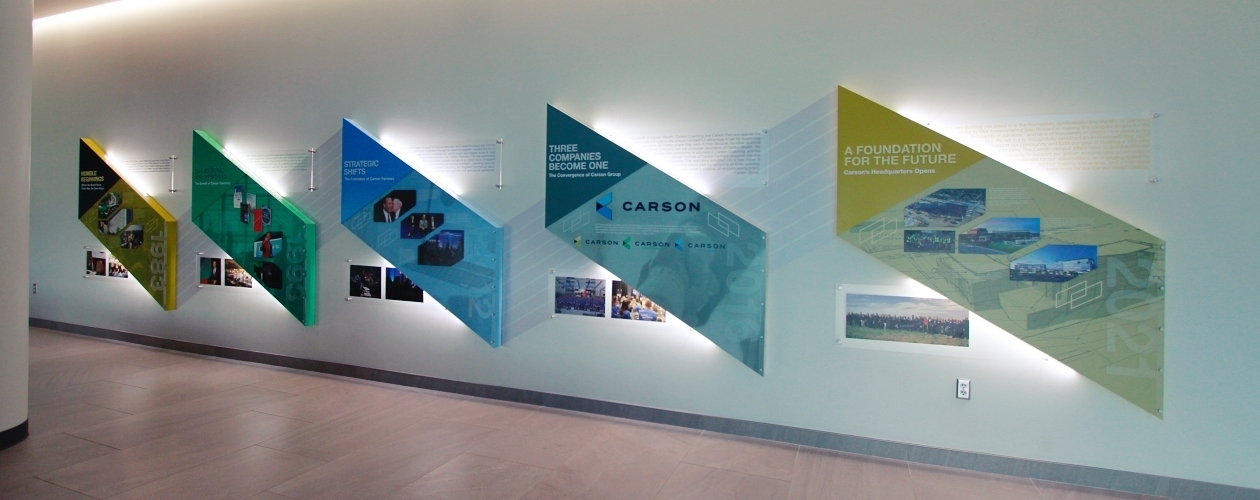
- The Design Solution: Rather than a flat timeline, the design team deconstructed the Carson Group logo, using its sharp, geometric angles as the structural building blocks for the display. The final installation consists of five distinct structural pods — each representing a major milestone or decade. Photographic elements were custom-cropped to match the angular shapes, while translucent overlays were layered on top to host clean typography and historical text.
Case Study 3: Aerie Crown Hebrew Day School
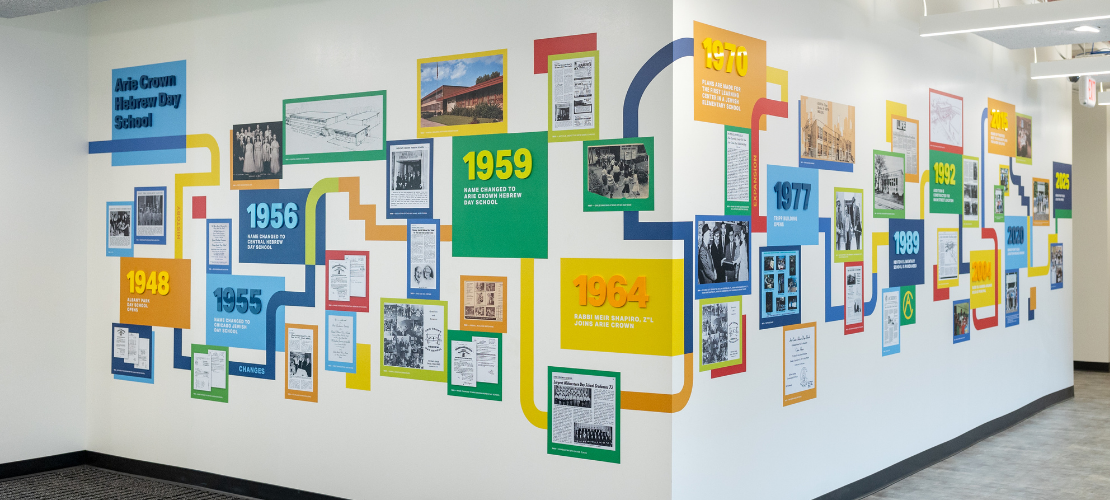
- The Challenge: Use a high-traffic school hallway to tell the story of Arie Crown from the 1940s to present day using submitted materials.
- The Design Solution: Because the display walls are in high-traffic areas, durable materials and mounting methods were chosen so that the elements will withstand generations of kids touching or leaning on them. The entire piece was over 35 feet long, about six feet high, spanning two walls.
Key Takeaways
- What is a history wall? An experiential graphic design installation that uses timelines, archival photos, dimensional lettering, and materials to tell an organization’s story.
- How do you plan a corporate timeline wall? By identifying the target audience, creating a priority list for historical milestones, and curating high-quality visual assets.
- How do you make a history wall unique? Move away from flat, linear templates with layered dimensional materials, custom geometric shapes, and integrated LED accent lighting.
Need Expert Guidance for Your Facility’s Signage?
Connect with us to bring your story to life.
Like what you see?
Get more ideas, design, and inspiration delivered to your inbox on a monthly basis. Sign up for our email, we won’t waste your time!