Easy Planning: 3 Factors for Smart Sign Budgets
Here’s where to start and how services needed, sign design, and project type all impact your budget for interior ADA signage, code signs, wayfinding signage, and more. Sign design and sign pricing examples are shared.
🐘 Budgets can be the elephant in the room, can’t they?
How do you budget signs with no quantities or designs?
Answer: Start early, pick a level, and ask for help!
For most projects, if we have an idea of the type and quality level of the project, along with a set of plans and an understanding of the services needed to get the project off the ground, we can provide a rough budget. Our Bronze, Silver, and Gold levels for sign materials, the floorplans, and the type of space (for example, healthcare, education, corporate, hospitality, etc.) allow us to create a budget range for signage. Our Planners are the best; they know how to address the type of project, identify the needs for ADA and Wayfinding, and create a budget based on years of experience with similar projects.
3 Most Impactful Factors to Your Sign Budgets:
1. Services Provided
Latitude’s Signage Planners and Experiential Graphic Designers have an advantage over traditional designers. Their access to in-house signage manufacturing allows them to see and know how signs are made, which means a more expedited process for clients. We design what we manufacture.
Options for Services include:
Planning
Assess ADA and Regulations | Learn and understand facility layout | Analyze traffic patterns | Develop messages and locations
Planning + Design
All Planning above + Identify design elements | Align with brand standards | Develop design options | Identify material selections | Create design recommendation
Design-Build
All Planning + All Design + Signage Manufacturing and Installation
Below are deliverables, which include a message schedule, location plan, and production drawings.
2. Level of Sign Design
For budgeting purposes, we’ll explain our 3 Levels of Sign Design here:
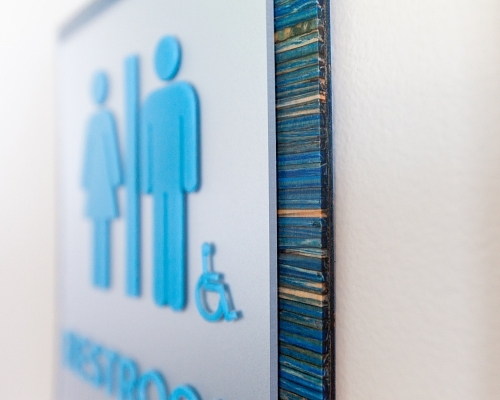
Bronze is the most standard offering, along with acrylic panels, applied copy, or directly printed dimensional lettering. This is a quality design and product that integrates well to any environment. This level does not include laminates, fine woods, or metals.
Silver allows for more custom aspects, including subsurface graphics, multi-layer construction, and minimal standoff. The materials used for the Silver line take advantage of ambient light using clear and/or frosted finishes. ADA needs are met with either an applied copy and Braille or a photopolymer with integral text and Braille. This level could include the addition of minimal accents and is a good option for integrating some simple architectural elements.
Gold is the most custom, highest designed, and most quality materials. This version allows for thicker and higher-end acrylics (green edge, mattes, or patterns) and multiple layers. This level makes a distinct statement and is idea for any architectural environment.
3. Size and Complexity of the Facility
Wayfinding and Traffic Flow: How much is really needed for your facility’s intent?
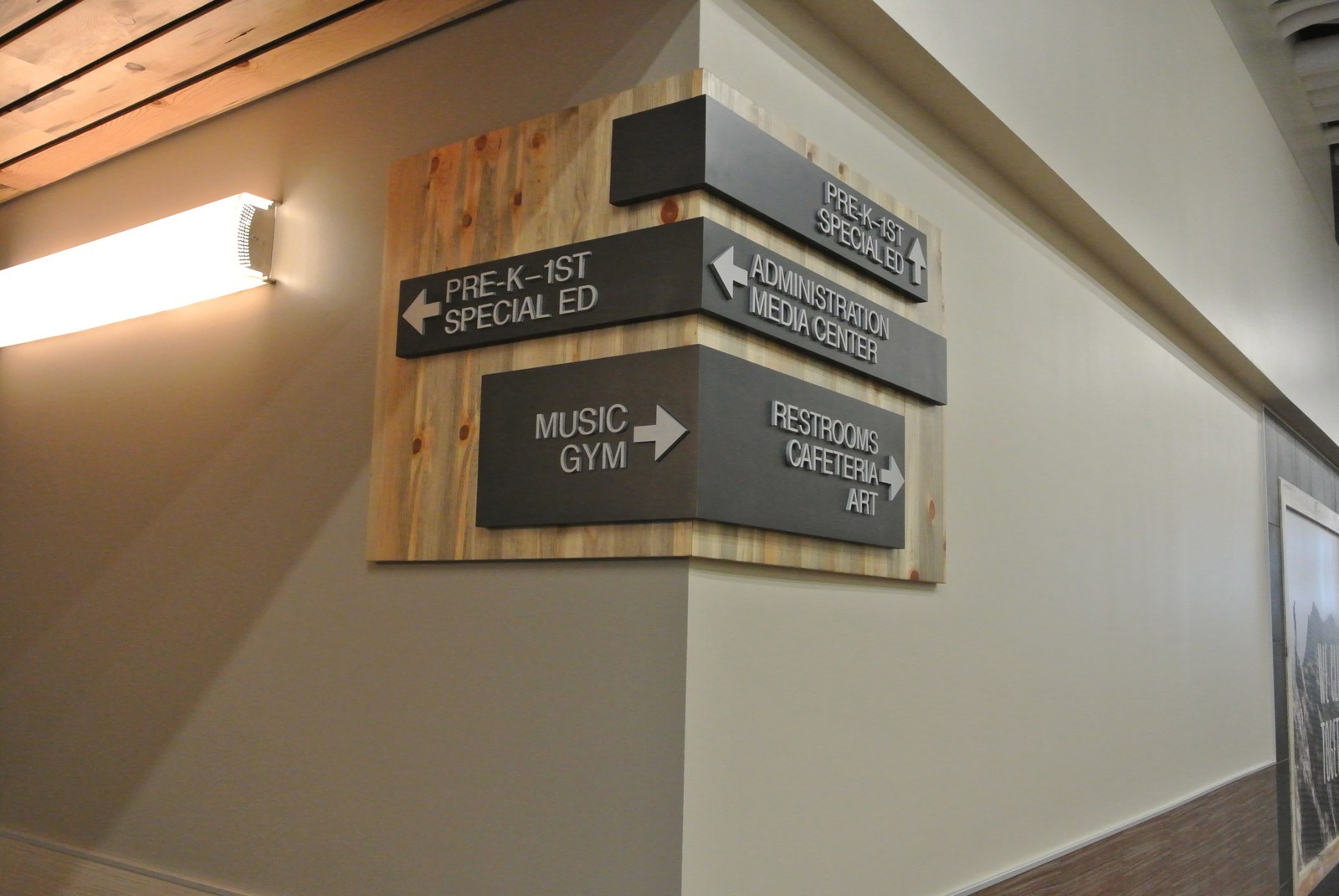
Wayfinding (getting from point A to point B, and back again) and traffic flow patterns are very important to review for hospitals and higher education projects. In these environments, visitors need to be able to get pretty far before they need someone to help them. On the flip side, in a corporate setting and K‑12 school projects the common goal is to have visitors check-in at the front desk. Either way, having a good understanding of the use of a facility and the goals of the visitor experience is relevant to signage planning and budgeting. Also keep in mind that over-signing is as ineffective as undersigning, so to create effective budgets the use of the space is taken into consideration.
Graphics and Brand: Create a lasting experience for your visitors.
Another aspect of the visitor experience is the impact of your brand. Those feelings people have in your space and they take these with them. In companion with the interior design of a facility, environmental graphics and effective branding can create a lasting experience by creating feelings and a memorable experience. These experiential features will want to have a budget put to them even if you don’t know precisely what it will be yet.
Budget Ranges
It is important to consider design and installation in legitimate project budgets for all three levels. A thorough and complete budget discovery, product application, and actual site location are required to appropriately budget for installation, which is typically 15% — 25% of the estimated product cost, depending on scope, difficulty, and other factors. On the design side, we typically budget 12% — 15% of the estimated product cost.
In this example, we used a corporate space with three floors. In a corporate setting, we take into account ADA Room Signs, Changeable Office Signs, Basic Wayfinding, and Code Signage (Stairwells, Restrooms, and Evacuation Maps).
Bronze Level Signage: $14,000-$17,000
Silver Level Signage: $17,000-$22,000
Gold Level Signage: $23,000-$28,000
*No exterior signage is considered.
BONUS: Material Selection: Value Engineering and Sign Design
Value Engineering: A bonus when you work directly with a signage manufacturer. This is the thoughtful use of budget without compromising design intent.
This is also where we can get creative by “value engineering” designs if we need to help dial in budgets. Through value engineering, we aim to give similar product options to help loosen the budget while not compromising the design intent, functionality, and overall quality.
Material selection can make a big difference in cost. For example, there is a substantial difference between a painted silver acrylic panel, a ¼” thick aluminum panel, and 1⁄2” thick stainless steel panel. While they are all “silver” in appearance, each version has benefits and drawbacks.
Painted acrylic will be super cost-efficient and have a good look, but it wouldn’t be appropriate for exterior environments, may not hold up as long, and would not have any metal ‘grain’ to it.
¼” aluminum would be a better metal choice at mid-range pricing. It is appropriate for interior or exterior use and can be routed or curved.
½” stainless will look beautiful, have great dimension at that thickness, and last forever, but it will be heavy, expensive, and not very flexible for routing, curving, or installing.
Learn more about Material Swaps here.
Another budget tip: Utilize “Front of House” and “Back of House” designs for signage
Another way to thoughtfully budget signage is to create a “front of house” and “back of house” designs. Basically, by having a simpler version for the back of house signage funds These designs can be the very same design with just simple product swap out or they can be different designs altogether. The goal is to stretch your budget a little further for the signs that people see on a regular basis by skimping a little on those signs that are not viewed by the public.
Have questions? Need help with a budget?
Find your local expert or email us today.
Like what you see?
Get more ideas, design, and inspiration delivered to your inbox on a monthly basis. Sign up for our email, we won’t waste your time!